 Sep 28, 2026

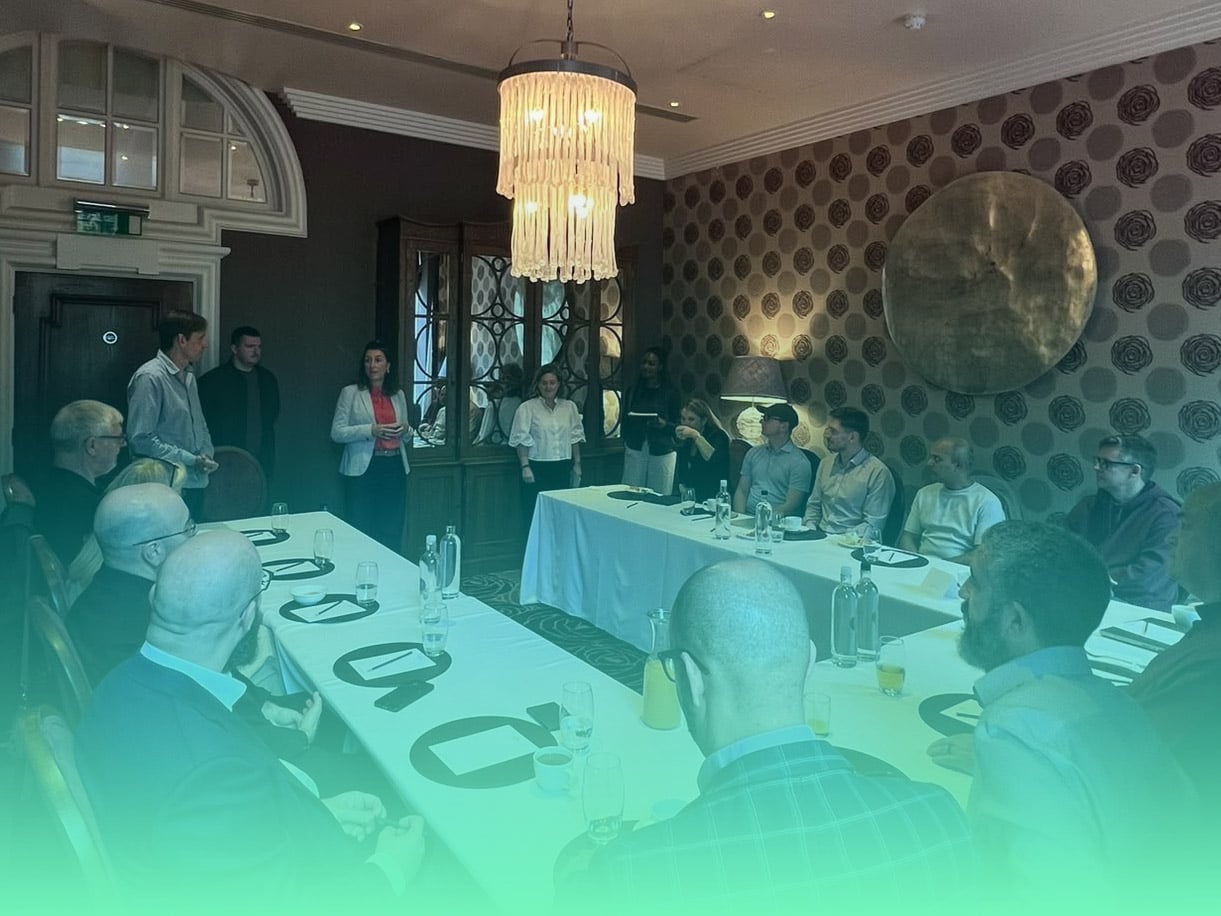
On Thursday 24th September, a group of 16 technology leaders ranging from CTOs, CIOs, AI directors, and heads of data and engineering gathered in The Library at The Roseate Hotel, Reading, for our AI Strategy Exchange breakfast roundtable, focused on moving AI initiatives from ambition to real ROI. Nana Fifield, Director of Aethel Advisory and former technology executive at Amazon Prime Video, and Melanie Marchant, Head of Consulting at Zühlke, facilitated the session. Industry backgrounds in the room spanned technology consulting, retail, publishing, healthcare, energy, software, cybersecurity, and utilities. The brief was simple: share what's working, be honest about what isn't, and compare notes with peers facing the same pressures.
What was on leaders' minds before the session
Ahead of the event, we asked every attendee which AI challenge they'd most value other leaders' take on. A few themes came up again and again. The first was the pace of change, and how hard that makes planning when everything dates so quickly. The second was ROI, particularly demonstrating the value of token spend against people costs. Others raised controlling the spread of AI tools across the business, getting the right context and knowledge into AI systems, and winning leadership trust. As one respondent put it, the goal is to get decision-makers to approve a true rethink of how the organisation works, "rather than just automate existing inefficiencies."
Where AI is already delivering
Real results were abundant. One technology leader cited the ability to deliver a product in just 12 months using an AI-enabled approach, against an estimated three years through its traditional lifecycle. That product is now live and in use at three target clients. In customer service, one implementation cut complex-case resolution from around an hour to minutes by helping agents access the data they needed faster. It kept its human agents, reported cost savings of around 15%, and tracked progress through cost, time, NPS and employee engagement. A cybersecurity team was also deploying an interesting use-case of AI to assess product code against more than 500 controls and generate Cyber Resilience Act documentation, with human review still firmly in the loop.
Generally, engineering leaders described work being completed in a week or two that would once have been estimated in months. But the group added a caution: speed alone doesn't prove something should be built.
AI amplifies what's already there
Data maturity was named, repeatedly, as the principal blocker to AI value. Legacy systems, fragmented data, conflicting documents and unclear ownership all hold organisations back, and many want AI outcomes without doing the groundwork first.
The group was clear that AI doesn't hide weaknesses. It exposes them. Access control was a particular concern: AI search can surface sensitive material, such as salary or M&A information, that was technically accessible all along but previously hard to find. Organisations need to build guardrails into their own systems rather than assume external models provide them. Governance can't be a one-off approval either, because the tools change too quickly. And if controls are too restrictive, people move work into personal tools and unapproved apps.
AI shouldn't be the hammer
One of the liveliest discussions centred on boards and executive teams. The pressure to "use AI" is real, but it can become a top-down mandate without enough clarity on the problem, the value or the risks. Melanie summed it up with an adage: if the only tool you have is a hammer, everything looks like a nail.
Several leaders stressed that AI works best alongside conventional software, automation, APIs and established engineering practice, not as a replacement for all of it. Sometimes a script, an integration or an existing product is the better answer. Cost was another reason for discipline. Token use and complex workflows can make AI more expensive than expected, occasionally more than a person handling the same task. The advice was to choose the smallest suitable model for each job and reserve larger models for review or more complex work.
Measuring value beyond headcount
There was real concern that AI is too often framed as a way to cut headcount. Leaders argued ROI should also capture service quality, revenue growth, product acceleration and customer retention. One customer-service example showed AI acting as a growth enabler: faster responses improved service, and people were kept on for complex cases. Lower query volumes shouldn't automatically be read as failure.
What this means for teams and skills
Nobody in the room believed AI removes the need for skilled engineers. The expected shift is towards architecture, data modelling, context-setting, review, security and solution design. The analogy that resonated most was treating AI like a fast, knowledgeable junior colleague: it needs clear direction, the right access, and someone checking its work.
Leaders also noted that access to AI tooling is fast becoming something developers expect, with implications for recruitment and how employers are perceived in the market. One open question stayed with the group: if AI takes on more routine work, how do organisations preserve the pathways that turn junior talent into tomorrow's senior engineers?
Three things to take away
1. Fix the foundations first. Data readiness, access control and governance decide whether AI creates value or amplifies existing problems.
2. Start with the outcome, not the tool. Be clear on the problem and the trade-offs, then decide where AI is genuinely the right fit.
3. Measure value broadly. Cost savings matter, but so do service quality, growth, speed to market and the people you retain.
Our thanks to Nana Fifield and Melanie Marchant for facilitating such an open and candid discussion, and to every leader who shared their experience around the table.
If you're building or reshaping a team for the AI era, book a hiring 1-2-1 with our team today.